By Millie Earle-Wright
Published: Nov 03, 2025More by Millie
Close
Articles by Year
- January 2026
- November 2025
- August 2025
- June 2025
- May 2025
- January 2025
- September 2024
- August 2024
- July 2024
- June 2024
- March 2024
- December 2023
- July 2023
- June 2023
- May 2023
- April 2023
- February 2023
- January 2023
- December 2022
- June 2022
- March 2022
- October 2020
- September 2020
- August 2020
- May 2020
- April 2020
- March 2020
- February 2020
- January 2020
- November 2019
- September 2019
- August 2019
- June 2019
- May 2019
- April 2019
- March 2019
- February 2019
- January 2019
- October 2018
- September 2018
- May 2018
- April 2018
- March 2018
- February 2018
- November 2017
- May 2017
- August 2016
- May 2016
- March 2016
- September 2015
- October 2014
Articles by Category


Fàilte gu Alba / Welcome to Scotland
On the 30th of November each year, people come together to celebrate St Andrew, the patron saint of Scotland. The celebrations often include the very best of Scottish culture – delicious food and drink, traditional music, and of course, ceilidh dancing. But who was St Andrew, and why does he hold such an important place in Scotland’s history?
Who Was St Andrew?
St Andrew was one of Jesus’ twelve Apostles and, like his brother St Peter, was a fisherman by trade. Not much is known about his early life, or indeed exactly where he preached; however, it is believed that he travelled great distances to spread the word of Jesus.
One legend suggests that St Andrew travelled to Scotland and established a church in Fife (an eastern peninsula) at the site that would eventually become the town of St Andrews. Another story claims that after his death, several of his relics were brought from Patras in Greece to Kinrymont in Fife after a shipwreck. Regardless of either legend’s factual accuracy, their presence goes some way to explaining why the saint is tied so closely to Scotland.
There is more consensus over St Andrew’s death, where, according to tradition, he died on the 30th of November in Greece by crucifixion. It is said that he requested to be bound to a diagonal cross, feeling unworthy to die on the same shape of cross as Christ. This X-shaped design later became the symbol of the Saltire, Scotland’s national flag.
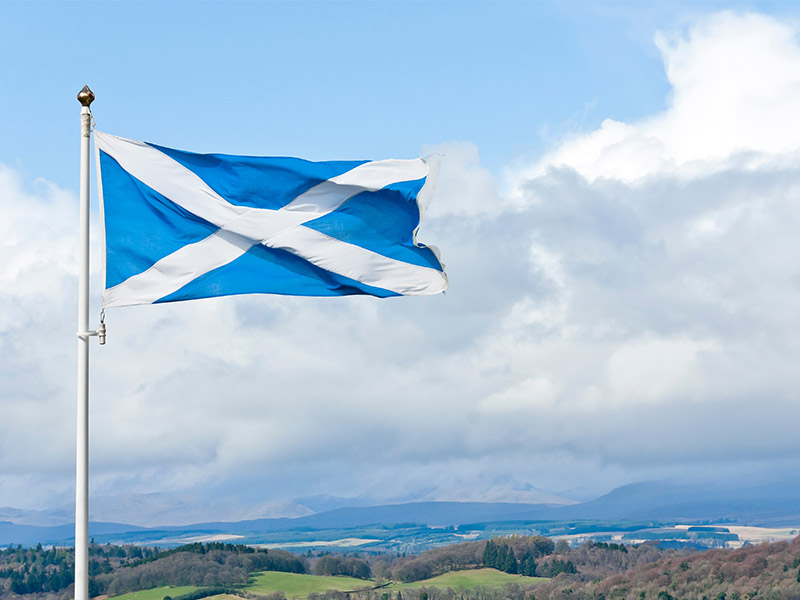
Scottish Flag
How Did St Andrew Become Scotland’s Patron Saint?
Although St Andrew’s association with Scotland dates back to the early medieval period, his role as patron saint was formally acknowledged around the time of the Declaration of Arbroath in 1320. This historic document asked Pope John XXII to recognise Scotland’s independence and acknowledge Robert the Bruce as the country’s lawful king. It also identifies St Andrew as Scotland’s patron saint.
“As long as a hundred of us remain alive, never will we on any conditions be subjected to the lordship of the English. It is in truth not for glory, nor riches, nor honours that we are fighting, but for freedom alone, which no honest man gives up but with life itself”. The Declaration of Arbroath, 6 April 1320
How Is St Andrew’s Day Celebrated Today?
Though St Andrew’s Day has been celebrated in Scotland for over a millennium, it became an official bank holiday in 2006 under the St Andrew’s Day Bank Holiday (Scotland) Act. Despite its status, it is not compulsory for businesses to give their employees a day off, therefore celebrations often occur after the working day has finished.
Whether the gathering is very small (a family dinner and a raised glass) or marked more merrily (ceilidh in the village hall anyone?), the spirit is the same – the joy of sharing good food, lovely company, and a strong sense of Scottish pride.
Group Dinner
Traditional Scottish Dishes for St Andrew’s Day
A St Andrew’s Day feast often features hearty local food, such as:
- Cullen skink – a creamy soup made from smoked haddock, potatoes, and onions.
- Haggis, neeps and tatties – the nation’s signature dish, served with mashed swede and potatoes.
- Cranachan – a sweet dessert of whipped cream, raspberries, toasted oats, honey, and a dash of whisky.
Pair these with a dram of whisky or a pint of Scottish ale, and you have a meal worthy of celebration.
Where to Celebrate St Andrew’s Day in Scotland
Festivities take place across the country, from the ancient university town of St Andrews in Fife to Edinburgh, Glasgow, and countless smaller communities that mark the day with music, dancing, and family events.
If you’re travelling in Scotland at this time of year, consider combining the celebrations with a trip to the Cairngorms National Park. The nearby village of Braemar offers an inviting mix of history, culture, and striking scenery.
Take a gentle nature walk through the pine forests, learn about local foraging traditions, or enjoy a peaceful picnic on the moors surrounded by the crisp mountain air. It’s a memorable way to experience the quieter side of Scotland’s winter landscapes while still feeling part of the national celebration.

Loch Muick, Braemar
